
1. Video, Video, Video
Thanks to greater bandwidth, cheaper storage, and a proliferation of products and services that make shooting, storing, viewing, and sharing video easy (Flip video, iPhone 3GS, YouTube, vimeo, blip.tv, vodpod, etc.), video will be king in 2010. Video is ideal because it allows careerists to deliver a complete communication and convey their personality—a critical component of branding.
2. Hiring Process
Companies will be hiring brands rather than employees. They will use social networks and Google to source talent, filter candidates, and validate credentials. "What's your brand?" will become as standard an interview question as "Tell me about yourself."
3. Branded Partners
Often more traditional in their approach to marketing and delivering their services, professional-services firms (accounting, law, consulting, etc.) are going to jump on the "brandwagon" with reckless abandon in 2010. In 2010, personal branding will be integrated into all levels in a firm—from hiring through becoming partner.
4. For-Credit Courses
Personal branding is a critical part of preparing students for successful careers.
5. Unified Search
We are already seeing many new services, such as addictomatic.com, that combine search results from many different search engines.Those who are building their personal brands will need to use various tools to ensure their visibility is positive and pervasive.
6. Video Search
With the huge growth in video on the Web (see prediction No. 1), we will start to see more sophisticated search capabilities within videos. Currently, most search tools use titles and meta-tags to evaluate the video content to include in search results. That will change—making video the most powerful tool for brand-building.
7. Increased Efficiency
New services are available to make the process of maintaining your brand online quicker, more efficient, and more integrated. Tools such as KnowEm, HelloTxt, and png.fm help you build your personal brand on the Web in less time and with less effort.
8. Personal SEO
SEO is just as important to people who are looking to build their brands. Of course, most of us cannot afford to have a full-time SEO expert on staff. That's why companies such as QAlias and PeoplePond have sprung up. Their services are great for career-minded professionals—especially those who have a common name or share their name with a celebrity. More such tools will become available and popular in 2010.
9. Digital Dirt Elimination
As Google results affect more aspects of our lives (getting a job, a loan, a date, etc.), people will engage firms such as ReputationDefender, Defend My Name, and Online Reputation Manager to eliminate digital dirt.
10. Permanent Mindset Shift
The confluence of Web 2.0 technologies and today's economic climate due to the subprime mortgage meltdown has changed the way we think about our careers.As we start to think of ourselves as companies of one, we will be more likely and more comfortable outsourcing activities related to our personal brands—building a management team to help us achieve our professional goals.
Showing posts with label Personal Branding. Show all posts
Showing posts with label Personal Branding. Show all posts
Sunday, March 10, 2013
William Arruda's Personal Branding Predictions

Personal Branding is about Fashion

I recently presented my pitch on personal branding at two lunch time events in Sunnyvale. On the first occasion I wore tan corduroy pants with the shirt you see above. And more recently I wore black pants with the same shirt. I didn't really think too much about it except that I know this is a good color on me.
I started a small buzz when people realized that the business cards I was handing out before the event matched my shirt. I had several people remark about it to my surprise. I have been dressing up a bit lately since I shifted from being a software architect to being a business development social media evangelist who just happens to be an expert in personal branding.
We should never discount the impact color and style can make with other people. Color and probably fashion can play an important factor in developing your personal brand. I like a strong emotional color like orange - because if feels like me - articulate, personable, and warm. Companies pay huge amounts of money to get their brand colors just right. In my case my wife Jacquelyn paid a couple of hundred dollars to get my colors done so that she could shop for me. I learned alot about how to use my eye extension colors in my tie - when going on an interview. But to tell you the truth - I usually just select things I like - but more often than not it a good color for me too.
When I want to make an impression about my personality I like wearing things with some color. In contrast I love grey - but its not the best color to project my enthusiasm or my emotion.
My wife by the way used to work for Oracle and we always remarked how many employees there wore black. I always thought that made Oracle more intellectual than emotional. So I guess if you dont make you living connecting with others - the neutral colors are fine.
Knowing about yourself and the colors you look good in helps promote your brand. And in my case Ive noticed Im more confident when wearing comfortable but stylish clothing. And you never want someone to think that your are "Out of Style" Just as its important to stay current in your profession - its important both to have a memorable style while not reminding people of the 70's.
Living at the nexus of Technology, Service, Marketing and Evangelism
We should never discount the impact color and style can make with other people. Color and probably fashion can play an important factor in developing your personal brand. I like a strong emotional color like orange - because if feels like me - articulate, personable, and warm. Companies pay huge amounts of money to get their brand colors just right. In my case my wife Jacquelyn paid a couple of hundred dollars to get my colors done so that she could shop for me. I learned alot about how to use my eye extension colors in my tie - when going on an interview. But to tell you the truth - I usually just select things I like - but more often than not it a good color for me too.
When I want to make an impression about my personality I like wearing things with some color. In contrast I love grey - but its not the best color to project my enthusiasm or my emotion.
My wife by the way used to work for Oracle and we always remarked how many employees there wore black. I always thought that made Oracle more intellectual than emotional. So I guess if you dont make you living connecting with others - the neutral colors are fine.
Knowing about yourself and the colors you look good in helps promote your brand. And in my case Ive noticed Im more confident when wearing comfortable but stylish clothing. And you never want someone to think that your are "Out of Style" Just as its important to stay current in your profession - its important both to have a memorable style while not reminding people of the 70's.
Living at the nexus of Technology, Service, Marketing and Evangelism
Friday, March 8, 2013
Personal Branding - Expertise vs Expert

I have found that when we talk about ourselves we might say that we have some particular expertise in something and only rarely do we say "I am an expert". This is a personal branding mistake. For example, I might say that I have expertise in Java Software Architecture. But it would be better expressed as saying "I am a Java Software Architecture Expert".
And another thing, the more you repeat this phrase - the more people will believe it and refer to you as the "Expert". Saying that you have "expertise" is a commodity statement that is cast away from consciousness faster than you can finish the sentence. When branding yourself - you must refer to yourself directly - and you must create real impressions in the minds of your audience.
Internal and External Brand Mantras

We have all heard about taglines sometimes called "brand" taglines. A tagline is really an external mantra for your customers to resonate with. Its also important when developing a personal career brand to have an internal mantra. Just like the word "OM" - which is chanted to bring inner calm - we need an internal mantra to guide our career and to give it meaning.
Finding an internal mantra that "fits" is not an easy task. It relies on some deep reflection of your core values and then simplifying them into a single statement. I have found it helpful to catalog my values formally on a piece of paper. It should be an expression that helps you find your way along your career path. For me its about using a combination of skills in my career. I have always felt that I work best when bridging ideas, selling ideas, and uncovering deeper meaning and understanding of things.
photo credit SanDiegoJoey

What is a Personal Brand Tagline

Taglines aren't just for companies - they are for individuals. A tagline is a very short expression that conveys meaning to your audience. When developing a career we can use these short expressions in conversation or on our business cards to quickly help others understand who and what we are. A good tagline starts a conversation and provides context for everything that follows. Without any further preamble (Just do it), I am going to list some qualities of a good tagline.
Simple - A tagline should be very short - no more than 9 words.
Succinct - A tagline is to the point and not long winded.
Clear - A tagline is immediately understood.
Original - A tagline is not a stale reused expression.
Authentic - A tagline is genuine and conveys real values about you.
Positive - A tagline is best when expressed highlighting the good.
Memorable - A tagline is useless if its forgetable.
Believable - A tagline is credible.
Personal Branding is Outcome Thinking

Personal Branding - especially for your career has to do with setting and achieving goals. In essence - getting things done. We are not used to setting our own goals - more often we are buffeted about by forces around us. But branding ourselves in our career is about setting some personal goals and actually accomplishing them. In David Allen's book Getting Things Done he uses a term called "Outcome Thinking". He says "Thinking in a concentrated manner to define desired outcomes is something few people feel they have to do. But in truth, outcome thinking is one of the most effective means available for making wishes a reality". Its probably another topic - but a person who sets and achieves their own goals is a person that people respect - they make an impression - which is one of the main goals of branding. And David reminds us that when we think of the desired outcome first before acting - we can more easily accomplish what we set out to do.
The Personal Branded Avatar

Its important to present a representative image of yourself in all of your social network profiles. People respond visually and make very quick decisions about you. If your avatar is a cartoon its hard to take you seriously. One caveat to that is - if you are not concerned about your brand then the avatar could be anything. Sometimes you want to be anonymous or be known as something other than what you really are - thats playful and fun - but its not a personal brand.
In branding its important to make a quick yet distinquished impression that conveys your value. Your avatar helps people start to establish trust with you.
All that being said - Peter Huboi has created for himself what I call the "best avatar on the web". It has a clear image of his face but also includes some other elements which make you want to find out more. Its brilliant and I never seem to tire of seeing it. While Peter doesnt use it everywhere - its a refreshing change of pace.
Personal Branding Is Made To Stick
Like any branding - its about marketing and the ability to be memorable. Its unfortunate that most of us are terrible at making impressions. The good news is that there is a simple recipe which you can use to improve. I simply cant recommend the book Made To Stick by Chip and Dan Heath enough. You gotta read the whole book to get the whole picture - or at least start reading their columns in Fast Company. These two brothers provide some simple guidelines that can be remembered by the acronym SUCCES(S).
Simple - Keep your message short, tight and to the point
Unexpected - Say something unusual but poignant to keep attention
Concrete - Give me some vivid details to make it real
Credible - Give me some facts and statistics
Emotional - Tell me whats in it for me
Stories - Stories help people understand and move them to action

Simple - Keep your message short, tight and to the point
Unexpected - Say something unusual but poignant to keep attention
Concrete - Give me some vivid details to make it real
Credible - Give me some facts and statistics
Emotional - Tell me whats in it for me
Stories - Stories help people understand and move them to action

Personal Branding Is the New Black

Personal branding is now something everyone must have in their career "wardrobe" - it has become the staple for professional success. I for one am relieved that the expectations are so high. We can no longer just be cogs in the machinery where somebody else takes care of us. It was nice - now I feel like an adult and in full control of my life - and its not vanity but invention - its re-establishing my identity in an all too over-populated world where I am responsible for my own promotion. But I also feel comfortable and confident - knowing I can always pull out my black dress (slacks) to wear to the party.
Personal Branding - I am the Singularity

The number one rule of personal branding is to be unique - possibly the best in the world as Seth Godin suggests in his book The Dip. This is not as hard as it might seem - it just takes a bit of self reflection to find the things that differentiate yourself from the rest of the commodities out there in the world. Its a bit about finding your own personality and being ok with it - because being yourself and having a special point of view sometimes makes you at odds with the lemmings. When you find your own inner strength and creativity you will find that it also results in a great amount of magnetism that will draw energy and people toward you like a black hole.
The Brand Called You - Tom Peters - Fast Company

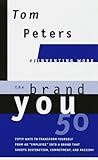
It's a new brand world.
That cross-trainer you're wearing -- one look at the distinctive swoosh on the side tells everyone who's got you branded. That coffee travel mug you're carrying -- ah, you're a Starbucks woman! Your T-shirt with the distinctive Champion "C" on the sleeve, the blue jeans with the prominent Levi's rivets, the watch with the hey-this-certifies-I-made-it icon on the face, your fountain pen with the maker's symbol crafted into the end ...
You're branded, branded, branded, branded.
It's time for me -- and you -- to take a lesson from the big brands, a lesson that's true for anyone who's interested in what it takes to stand out and prosper in the new world of work.
Regardless of age, regardless of position, regardless of the business we happen to be in, all of us need to understand the importance of branding. We are CEOs of our own companies: Me Inc. To be in business today, our most important job is to be head marketer for the brand called You.
It's that simple -- and that hard. And that inescapable.
Behemoth companies may take turns buying each other or acquiring every hot startup that catches their eye -- mergers in 1996 set records. Hollywood may be interested in only blockbusters and book publishers may want to put out only guaranteed best-sellers. But don't be fooled by all the frenzy at the humongous end of the size spectrum.
The real action is at the other end: the main chance is becoming a free agent in an economy of free agents, looking to have the best season you can imagine in your field, looking to do your best work and chalk up a remarkable track record, and looking to establish your own micro equivalent of the Nike swoosh. Because if you do, you'll not only reach out toward every opportunity within arm's (or laptop's) length, you'll not only make a noteworthy contribution to your team's success -- you'll also put yourself in a great bargaining position for next season's free-agency market.
The good news -- and it is largely good news -- is that everyone has a chance to stand out. Everyone has a chance to learn, improve, and build up their skills. Everyone has a chance to be a brand worthy of remark.
Who understands this fundamental principle? The big companies do. They've come a long way in a short time: it was just over four years ago, April 2, 1993 to be precise, when Philip Morris cut the price of Marlboro cigarettes by 40 cents a pack. That was on a Friday. On Monday, the stock market value of packaged goods companies fell by $25 billion. Everybody agreed: brands were doomed.
Today brands are everything, and all kinds of products and services -- from accounting firms to sneaker makers to restaurants -- are figuring out how to transcend the narrow boundaries of their categories and become a brand surrounded by a Tommy Hilfiger-like buzz.
Who else understands it? Every single Web site sponsor. In fact, the Web makes the case for branding more directly than any packaged good or consumer product ever could. Here's what the Web says: Anyone can have a Web site. And today, because anyone can ... anyone does! So how do you know which sites are worth visiting, which sites to bookmark, which sites are worth going to more than once? The answer: branding. The sites you go back to are the sites you trust. They're the sites where the brand name tells you that the visit will be worth your time -- again and again. The brand is a promise of the value you'll receive.
The same holds true for that other killer app of the Net -- email. When everybody has email and anybody can send you email, how do you decide whose messages you're going to read and respond to first -- and whose you're going to send to the trash unread? The answer: personal branding. The name of the email sender is every bit as important a brand -- is a brand -- as the name of the Web site you visit. It's a promise of the value you'll receive for the time you spend reading the message.
Nobody understands branding better than professional services firms. Look at McKinsey or Arthur Andersen for a model of the new rules of branding at the company and personal level. Almost every professional services firm works with the same business model. They have almost no hard assets -- my guess is that most probably go so far as to rent or lease every tangible item they possibly can to keep from having to own anything. They have lots of soft assets -- more conventionally known as people, preferably smart, motivated, talented people. And they have huge revenues -- and astounding profits.
They also have a very clear culture of work and life. You're hired, you report to work, you join a team -- and you immediately start figuring out how to deliver value to the customer. Along the way, you learn stuff, develop your skills, hone your abilities, move from project to project. And if you're really smart, you figure out how to distinguish yourself from all the other very smart people walking around with $1,500 suits, high-powered laptops, and well-polished resumes. Along the way, if you're really smart, you figure out what it takes to create a distinctive role for yourself -- you create a message and a strategy to promote the brand called You.
via fastcompany.com
This is the article from Fast Company by Tom Peters that arguably started personal branding.
Personal Branding Is A Lens
Personal Branding is a way of looking at things. It is a lens through which we can interpret and decide if actions and behaviors are good or not. Most of the things about personal branding we already know about – but we dont always know what to apply and when. A personal branding lens groups and guides our thoughts and actions. It’s actually very exciting because I can now prioritize what I do using this “branding” lens.
I was thinking about this today when I set up my first Squidoo page. Squidoo is a site set up by that marketing genius, author and agent of change Seth Godin. It allows you to set up any number pages which they call a “Lens”. These lenses are just a particular persons view of things – their perspective. So I think Personal Branding concepts are a lens which gets placed on our lives and our careers. And I know that when we have a “focus” things are easier.

Personal Branding - Dont Be the Invisible Man
Everybody has heard of the Invisible Man by H.G. Wells. The Invisible Man in the story is a scientist who theorizes that if a person’s refractive index is changed to exactly that of air and his body does not absorb or reflect light, then he will be invisible. He successfully carries out this procedure on himself, but cannot become visible again, becoming mentally unstable as a result.
Without personal branding most of us are exactly like the Invisible Man – but without going through the “procedure”. Personal Branding is a procedure in which we make ourselves visible to the marketplace. We want to become the opposite of the Invisible Man. Personal Branding helps us find shelf space in the market by actively presenting ourselves consistently, repeatedly, and authentically.

I wasnt going to describe the whole “procedure” of becoming visible (and regaining your mental stability). But just off the top of my head you can start with these things:
- It sounds simple – but just show up to events. Ideally show up early. As Woody Allen said “90% of Life is just showing up”.
- Have and express a opinion. Nothing makes you noticed more than saying something pertinent.
- At work – volunteer to run meetings, to set things up, or to organize events. Your name will be splashed everywhere.
- Blog about something that you are passionate about. Your simple reflections are valuable to others. Share some of your “hard earned” insights.
- Set up a personal web site at “yourname”.com. This is the quickest way to show up in a google search on your name.
- Develop and nurture personal profiles on LinkedIn and on Facebook. Employers are looking online at your profile before they look at your resume or CV.
- Be friendly and introduce yourself to others. Make a point of using other peoples names and saying hello. Find out about other people and offer them something you have learned that would interest them – this is a great way to start a conversation – and have them remember you.
- Take any opportunity to speak to groups. Develop some insights in small portions on a blog – then share a set of these ideas to a group.
- Build and nuture your rolodex. Remember
“Your Network = Your Networth”. - Contribute to conversations on the web. Join some groups on LinkedIn and participate.
- Try “micro-blogging“. You can Twitter or send “Status Updates” on LinkedIn and Facebook. This gets your name in front of everyone on your network – a great invisibility killer. If you Twitter – add 100 things of value before you tell me what you are having for dinner. And for Status Updates – remind people of your expertise and that you are constantly learning.
Personal Branding is Telling Authentic Stories
Lately, Ive been attempting to come to grips with telling my personal story more effectively. I know its important to tell a good story in order to have people remember you positively. But I didnt really understand the power of story telling until I read Seth Godin’s book called “All Marketers Are Liars”. And before you misunderstand the title I have to tell you the subtitle is “The Power of Telling Authentic Stories in a Low-Trust World”.
The whole book is interesting but Im only going to relate a single story about Riedel drinking glasses. You probably know that Georg Riedel is a tenth-generation glassblower and his company produces all sorts of drinking glasses. He and his staff fervently believe that there is a perfect shape for every beverage. And according to the website “The delivery of a wine’s message, its bouquet and taste, depends on the form of the glass”. As it turns out, connoisseurs all will tell you that the glass makes a profound difference. In fact, I bought a couple of “special” scotch drinking glasses a few years back and always thought that they were the perfect delivery mechanisms. The funny thing is that in blind tastings – there is no difference. What does that tell you?

Wednesday, March 6, 2013
Tips For A Well Branded Blog
- You cant blog unless you already have a personal brand. I joke about this – but I really believe that you cant blog sustainably unless you find your voice, have an opinion, and have something valuable to say. Having a brand is like being in the groove – and when you are in a groove – things roll along.
- Start with an attention getting title. If you dont capture an audience in the first sentence – you have lost them. The title is going to show up in a list of your blogs and that is all that will be visible. It has to stand out.
- Make your first sentence powerful – if not controversial. I often cross post my blogs to writerspan.com in order to get more visibility and let them monetize it for me. WriterSpan.com takes its content and shoves the title and the first sentence or two out to 30,000 community websites. So the whole post isnt visible – but the first sentence is.
- Make your Blog Readable. Nobody has the time nor inclination to read something that is so dense your brain hurts. So one technique is to judiciously use bolding. Making a keyword or concept bold draws the reader into the story.. You probably already know that bullet lists are easy to read – so I wont mention it (ha).
- Feel free to add some multimedia. Just text can be boring. If you have a image that you have rights to publish – add it to the page – it adds visual variety. Here is a picture of young jeffrey conteplating his future as a writer.
- Help your blog get Google Mojo. We all know that google pays attention to blogs and catalogs them regularly. You must ensure that your blog is tagged sufficiently. Tags are one way content gets classified and found on the net. So I always at least tag my articles with the word “Brand”. You can also sprinkle keywords here and there in your text to help getting found. Keyword analysis is both a science and an art but its worth knowing a little bit about it. If you use words in your title and your text that google users enter into the search field – then your article has a greater chance of rising to the top of the search engine results page (SERP). Another thing to pay attention to is the link (anchor) text. This is the underlined text as in this blog that opens another location. The best text is a keyword loaded phrase. So I might tell you that I am a forward thinking and charismatic software architect and social media evangelist to call attention to my domain or company. Having good keywords and well articulated link text is essential to be found.
- Develop your Writing Style. I think style comes from practice. You cant belabor everything you write. So the key is to let out some of your personality in the writing. Let some of it flow. I learned a lot from reading Strunk and White’s Elements of Style. One thing I learned was to mix up the length of my sentences and paragraphs. Small is good. It adds variety and keeps the reader engaged. There is a billion other tricks – I suggest that you try some out in your writing.
- Blogs can be Short. Dont be afraid to write a short blog. I myself have little paragraph ideas. I have friends that write essays. But I think I have been more successful at getting something written and published with the small pieces.
- Be Personal and Tell a Story. Don’t fear revealing a bit about yourself in everything you write. Writing is not just expressing intellectual ideas – its about expressing your “full” idea – its thoughts AND emotions. Develop your ability to tell a story. Chip and Dan Heath remind us that stories are a key element to making things stick in other people’s minds – which is an essential element to personal branding.
- Always Promote Yourself. There is always a chance to promote yourself in your blog – beyond being read or being syndicated using RSS. I always add my tagline at the bottom of the page with a link to one of my web pages. Its a simple reminder to others of my brand but also accumulates inbound links to my target site.

Twitter Tips For Personal Branding
I have been reflecting on how to be most effective on Twitter – and to use Twitter to convey my brand. Since my primary trade is a software architect – I immediately recognize what I think are best practices – in fact are probably patterns for success on Twitter. So here they are:

- First start with an interesting design. You can customize the Twitter page using what Twitter gives you. Or you can upload a custom background. I uploaded a simple image of the ocean – an image large enough to cover the entire background even when the browser is enlarged. Many others seem to upload images that have a lot of personal information about themself. See Chris Brogan’s page for example. Try viewing the background image to see what he is uploading. Im not entirely certain how these images are actually created. I have to report back later.
- Include a concise (Ha Ha Ha) profile that describes your brand. Make these words count. Sometimes, I use these words to make entire judgments about fellow Twitterers. Expressions like “Having Fun, Hanging Out” do not promote your brand. Say something significant so that others can follow you easily.
- Customize your Twitter ID. Mine is http://twitter.com/jeffrey_blake. I recommend that you use your own name – but without the underscore. (There seems to be some other jeffreyblake out there who grabbed it before me). So it behooves you to capture your name sooner than later. This is good advice for all the social networking sites. You are the brand – use your name or at least your tagline.
- Enter your real name so that when you are listed people don’t have difficulty identifying you.
- Upload a clear professional image of yourself. As a rule I don’t follow people who have goofy avatars or don’t wear shirts in their image – In fact, just like on linkedin I have a habit of removing those connections to protect my brand.
- Dont protect your updates. I think its important to share your ideas and fully take credit for them.
- As for Tweets – say something pertinent. Have a conversation. Add value when you can. Have a hundred relevant comments before you tell me what you are having for dinner.
- Follow everyone relevant to you. I started twittering because of Guy Kawasaki after hearing him talk about his new company alltop.com. Ideally, have real conversations with these people. In time these connections can expand to Linkedin or Facebook and beyond.
- Learn the Twitter Etiquette whatever that is. I enjoyed this one which had some relevant points.
- Cross advertise yourself in your blog, your website or in your social net profiles. Add your twitter address into your emails.
Personal Branding Makes Blogging Easy
Many people around me seem to be interested in blogging. Its almost as if they feel they are missing something if they don’t blog. Beyond selecting which blogger to use to create the posts – most people I know have difficulty figuring out what to write about sustainably. The primary reason people dont know what to blog about is that they don’t know what their personal brand is. If you have a clearly defined personal brand (especially for your career) – then blogging is easy. The reason is because a personal brand is about proactively pursuing ways to find meaning and providing value to the marketplace. It is about some amount of curiousity for new material. Blogging is a way for the personal brander to clarify thoughts that occur to them during a week, satisfies the need to share ideas, and establishes the brander as a person who has opinions and ideas. They establish themselves as a thought leader.

Ok, I understand its hard to clarify what your brand is. But if you have a personal tagline – you might start just writing about that. Sometimes we come up with these taglines for ourselves without really understanding them – they just ring true – thats a good sign. If you dont have a tagline to write about you might think about getting one – to help you clarify your brand. Im still working on mine – but I received a lot of insight after writing a personal marketing plan. I heard recently from Eric Rosen that one way to discover your tagline is to take a look at the recent parts of your resume. Either way – once you are clear about where you are going – writing about it becomes a lot easier.
Ok, I understand its hard to clarify what your brand is. But if you have a personal tagline – you might start just writing about that. Sometimes we come up with these taglines for ourselves without really understanding them – they just ring true – thats a good sign. If you dont have a tagline to write about you might think about getting one – to help you clarify your brand. Im still working on mine – but I received a lot of insight after writing a personal marketing plan. I heard recently from Eric Rosen that one way to discover your tagline is to take a look at the recent parts of your resume. Either way – once you are clear about where you are going – writing about it becomes a lot easier.
Sunday, February 22, 2009
Defending Your Personal Brand Online
So what do you see when you google your name. Is it a listing for a convicted felon or porn star? If you have an unusual name (like a well differentiated keyword) you will rise to the top automatically. But if you have an ordinary name you might not even show up. What you don't want to happen is to have a search result that doesn't represent you.
Living at the Nexus of Technology, Service, Marketing and Evangelism @ JeffreyBlake.com
- Your name is your brand so use it consistently. Dont dilute it by using different variations - pick one version of your name and stick with it.
- If you share a name with a famous person you might consider adding an initial to your online name. You need to be consistent with this however - also using the initial on your business cards and other correspondence.
- Capture your "branded" name in as many places as you can so that when someone else types it in - information about you appears. Be sure to customize your profile name using your "branded" name. For example, your Linkedin profile can be customized using your name - making it easy to remember and share. Its better to do this earlier than later - particularly on the fast growing social sites. I always lamented turning down the opportunity to have a gmail account when "jeffreyblake@gmail.com" was actually available. I would have preferred to own it as opposed to someone else.
- You should periodically check what other people are seeing on google about you. If you are a job hunter - rest assured that recruiters are checking you out online. So you will need to see what they see and take action if the results are unflattering. You will need to devise a campaign to add visibility.
- Another good thing to check in the google search is if good keywords are associated with your name. So you could try "Jeffrey Blake Architect" for example to find out about me. Try searching on your name a keyword associated with your profession. If nothing come up then you will need to do some work.
- You can easily automate your monitoring of your brand by setting up Google Alerts which can send you periodic reports on what is showing up on the web about your brand. I found that you need to experiment what you monitor to get the right mix of results.
- If you are invisible online there is a number of things you can do to increase your visibility and off the top of my head is to join some professional networks as Linkedin that show up well in searches. Contribute to online conversations using your well branded name.
- This should have been mentioned earlier - but go out and get a domain name using your brand name. Its OK to use something other than your name - but a using your name is most effective. Capture a .com domain if you can - because that is the most prestigious right now. Frankly I don't get ".biz" for an individual or a company.
- You can capture a custom profile URL at a zillion sites. I like to control my name before someone else. For example you can get custom profiles at Delicious, FriendFeed, LinkedIn, Twitter, HubPages, Facebook, Plaxo, and Reddit just to name a few. Follow your interests and signup can customize your profile.
Living at the Nexus of Technology, Service, Marketing and Evangelism @ JeffreyBlake.com
Subscribe to:
Posts (Atom)